Personal forwarding
Register and use it. One China address for every seller, a public calculator, the same receiving and consolidation workflow.
Why WooliiPorter · The China fulfillment network
WooliiPorter gives merchants who buy from their own China suppliers one integration to mainstream China cross-border fulfillment capacity. Each parcel is routed to the best carrier channel on its lane against a transit promise you chose — and that promise is frozen on the parcel, tracked to delivery, and settled against a bill you can reconcile line by line.
Three entries, all self-serve, none gated on size. Whichever you take, the same physical network and the same routing decision serve your parcels.
Register and use it. One China address for every seller, a public calculator, the same receiving and consolidation workflow.
Connecting a verified WooCommerce or Shopify store activates the merchant account immediately — the verified install is the review.
Submit the in-account integration application; a short review looks at cargo types and destinations, not at merchant size. No volume minimum, no platform fee.
Without a network, multi-carrier shipping means you negotiate with each carrier, compare each rate card, and maintain each integration yourself. WooliiPorter replaces that with one routing decision, run per parcel, in a fixed order — because the order is the policy:
Declared-value ceiling, weight, dimension and girth caps, cargo type (general, battery, cosmetic, liquid) and destination coverage are checked first. A channel that fails any one of them is out, whatever it costs. The gate fails closed: a parcel missing its declared value is treated as over the ceiling, not waved through.
You pick a transit band — a destination-and-time-range product such as 8–12 working days — and only channels banded at or inside that range stay in. Channels are banded by their upper bound, so a channel that sometimes runs faster never gets credit for its best day. The promise is frozen on the parcel at order time.
Price decides only among channels that already passed compliance and match your promise. Cost never overrides the first two layers — a cheaper channel that misses the band is not a bargain, it is a broken promise.
The network compounds without work on your side: each fulfillment provider WooliiPorter connects adds its full channel set to every shipment you book — zero changes to your store, your API client or your workflow. How the decision runs in detail: multi-carrier shipping from China; how the promise is constructed: transit-time bands.
The whole chain is digital, so an exception is a lookup rather than an email thread. Each link below is a recorded, queryable step on the same order timeline:
The warehouse operator scans the supplier parcel on a PDA at intake — photographed, weighed, measured, matched to your declaration.
If the parcel waits, its shelf location is recorded. Nothing sits in an untracked pile.
The outbound parcel is measured as packed. Your quote is priced from these numbers, not from an estimate.
The three-layer decision runs, and the outcome is logged — including why each rejected channel was rejected.
Dispatch is recorded, and carrier events merge into the same order timeline your China-leg events live on.
Settlement is a list of explainable line items that reconciles against the packed quote. You can diff them row by row.
These are unedited product surfaces with demonstration data — the same screens a merchant works in. Computed figures on them come from the live pricing and billing engines, not from a designer.
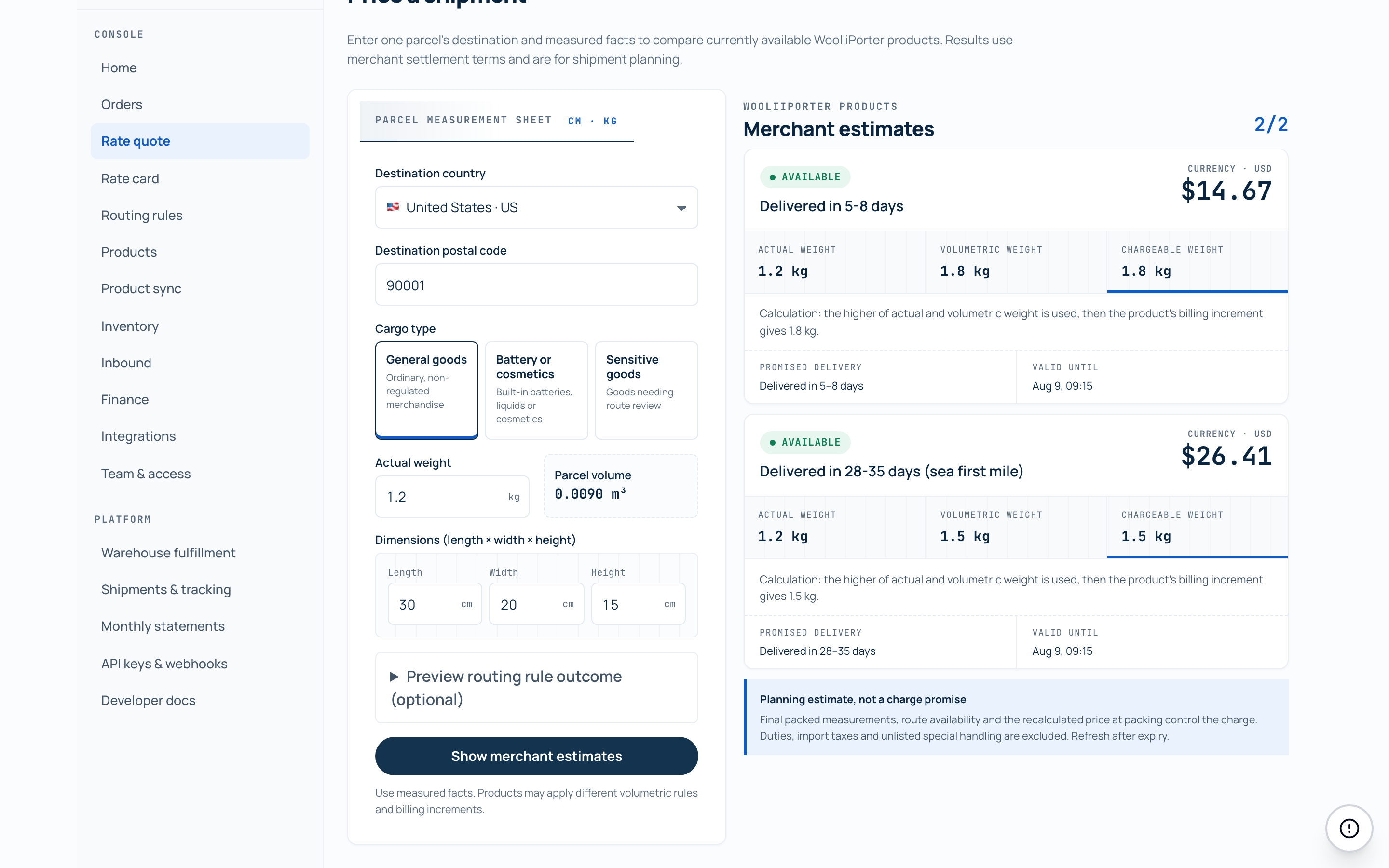
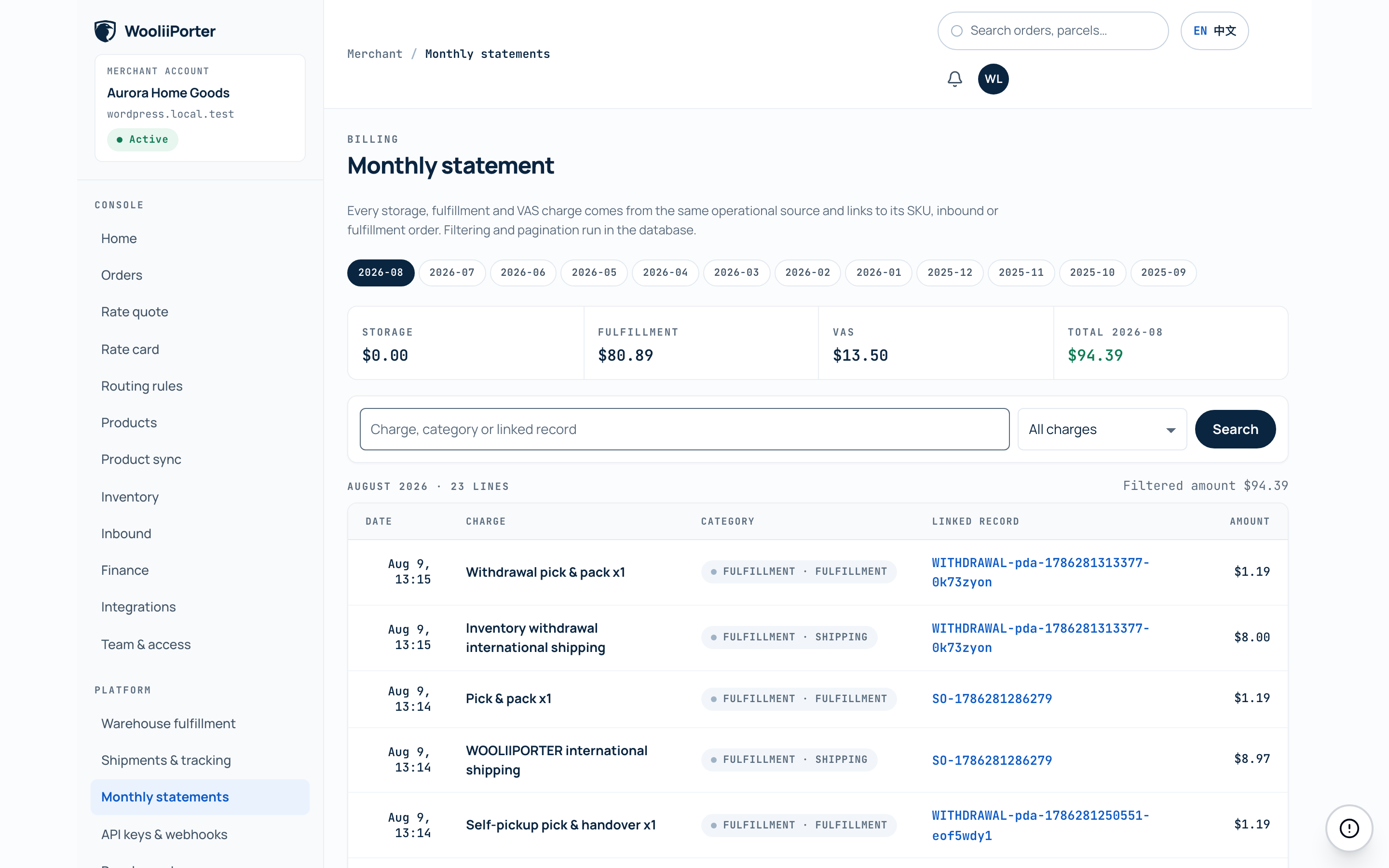
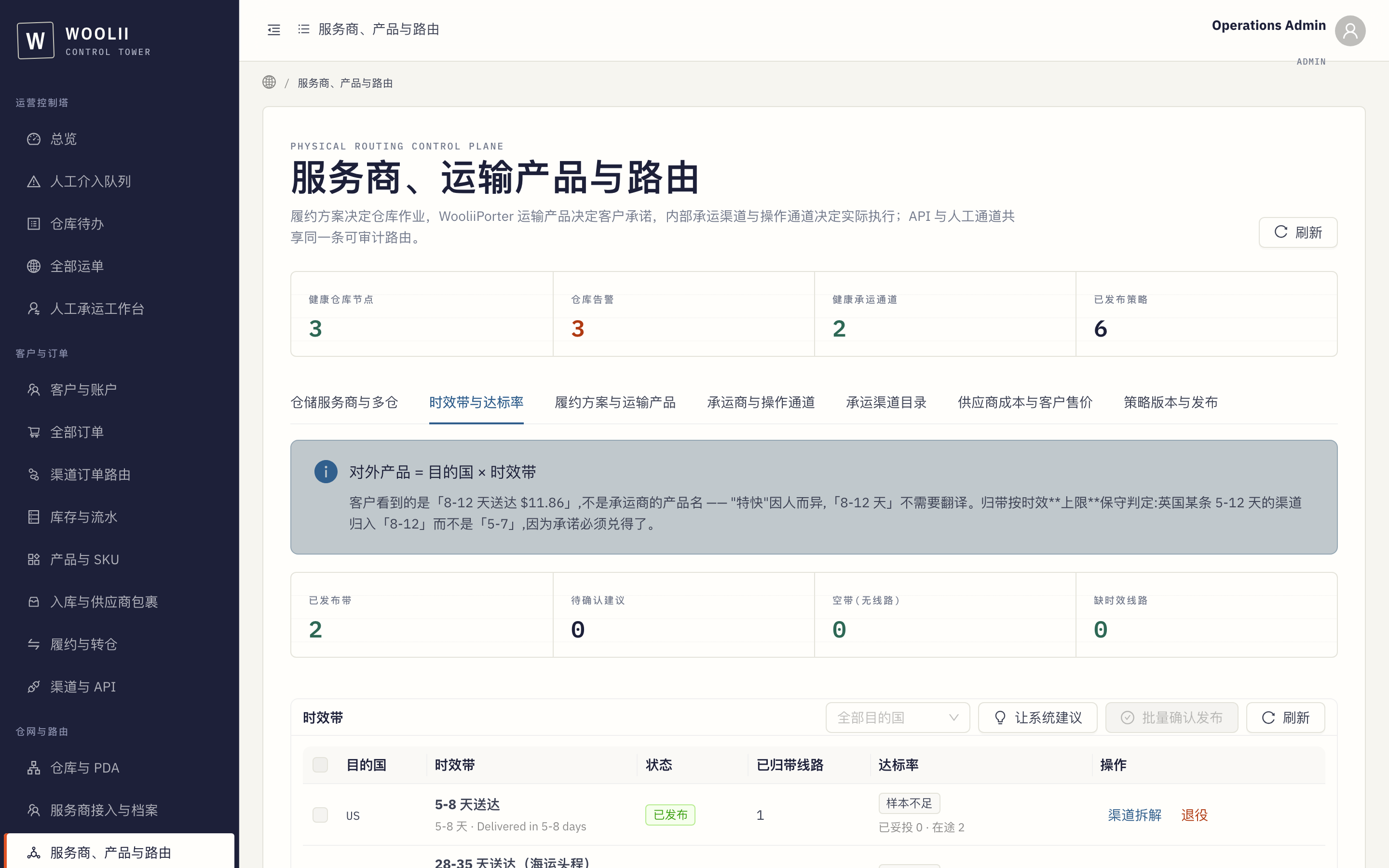
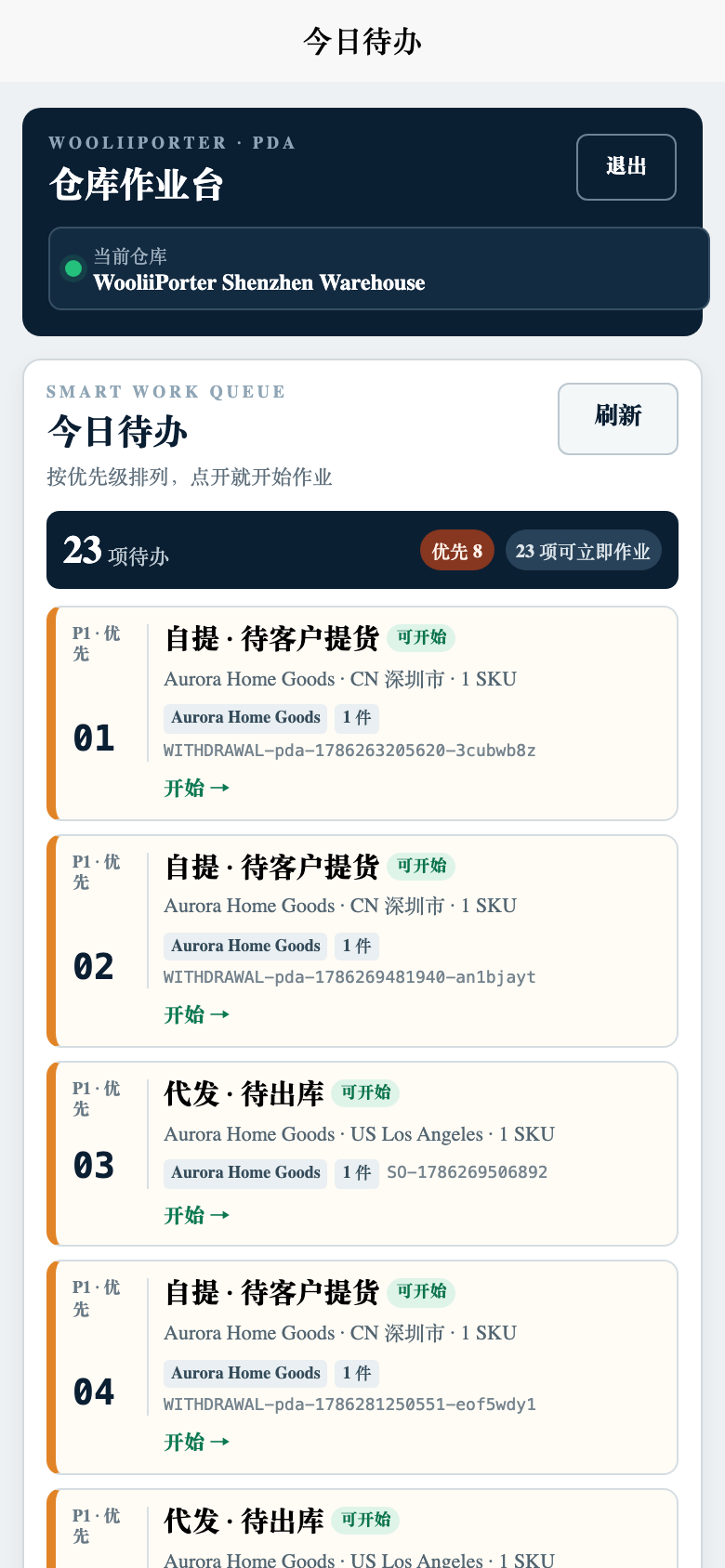
A promise is only worth what enforces it. WooliiPorter measures each carrier channel’s actual performance against the transit bands it is sold under — continuously, on real parcels. A channel whose measured performance slips is demoted in routing until it earns its band back; a band with no qualifying channel on a lane is simply not offered there. The consequence: the promise you see at booking is one the network currently keeps, not one it once kept.
WooliiPorter does not publish an aggregate on-time percentage. Attainment is measured per channel per lane and drives routing internally; publishing one flattering aggregate number would be marketing, not measurement. The mechanism — banding by upper bound, demotion on slippage, frozen promises — is the claim, and it is testable on your own shipments.
Nothing below asks for trust. Each row is a claim, the way to verify it, and the link that does so — all reachable logged out.
| Claim | How to verify it now | Link |
|---|---|---|
| Rates are computable by anyone | The personal-forwarding calculator prices lanes publicly, against the live rate table — no login, no sales call. | Open the calculator |
| The API contract is public before you have an account | The complete Merchant API V1 surface is published as an OpenAPI 3.1 document. Read every operation, then decide. | Fetch the OpenAPI 3.1 JSON |
| Pricing is machine-readable | The fee structure — every layer that can appear on a bill and the unit it is measured in — is published as a markdown document your tools can parse. | Read pricing.md |
| The terms are readable before signup | Every contract governing the account is public. Nothing is revealed only after you commit. | Read the terms |
| The plugin you install is the artifact we published | The WooCommerce plugin is listed on the WordPress.org directory, and its SHA-256 checksum is published — hash your download and compare. | See the listing and checksum |
| Bills reconcile line by line | The settlement structure is documented layer by layer, including the fees a clean bill should not contain. | Read the cost breakdown |
A rate aggregator compares prices for parcels it never touches: you pack, label and hand off, and the delivery outcome sits between you and the carrier you picked. WooliiPorter operates the warehouse the parcel passes through — receiving, prep, consolidation, packing — selects the carrier channel against a transit promise it freezes on the parcel, and tracks that promise to delivery on the same order record. Comparison hands you options; WooliiPorter signs its name to an outcome.
A traditional forwarder typically runs you on one dedicated line per destination — its line — and switching means renegotiating. WooliiPorter is a network: each parcel is routed across every connected carrier channel on its lane, screened for compliance, matched to the transit band you chose, then cost-selected. Each fulfillment provider the network connects adds its full channel set to every shipment you book, with zero changes on your side.
Yes. Routing is a property of the parcel and its lane, not of the account: the same compliance gate, the same transit bands, the same in-band cost selection run for a one-order-a-week store and a high-volume seller. There is no volume minimum and no platform fee, and every account starts with a zero-balance wallet — no warehouse work is billed before you fund and approve it.
The public calculator prices lanes without a login; the OpenAPI 3.1 contract publishes the full API surface; pricing.md publishes the fee structure in machine-readable form; the terms are public; and the WooCommerce plugin carries a published SHA-256 checksum you can compare against your download. Every mechanism claim WooliiPorter makes links to one of those surfaces.
No, deliberately. You choose your suppliers, order from them and pay them directly — the factory price never enters our systems. WooliiPorter’s role starts when the parcel reaches the warehouse and ends at your customer’s door, and goods stay merchant-owned the entire way, including optional stocked inventory.